Featured

“The Incredible Hulk” Issue #328 Review

“Piece of Mind”
Writer: Peter David
Artist: Dwayne Turner

Plot Summary: Bruce Banner is alone in the desert, somewhere in the southwestern United States, contemplating his many problems. The original gray Hulk has reemerged within him, and his relationship with his wife, Betty, is growing increasingly strained. In addition, Bruce’s longtime friend, Rick Jones, has been turned into a second Hulk, and Bruce is unsure how he can help him. Bruce’s inner turmoil will reach its peak when he encounters a mysterious old man in the desert as well as a new supervillain calling himself “Fragment”.

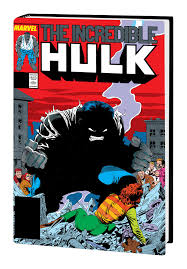
Thoughts on the Cover: I’ve always felt that a good cover is one which accurately represents the events within the issue and gets you excited to start reading. By that metric, this cover does its job even if it’s not the most memorable. All the characters in the issue are shown, and their placement around Bruce’s kneeling figure shows the extreme stress he experiences in this story as if they’re all metaphorically pulling him in different directions.
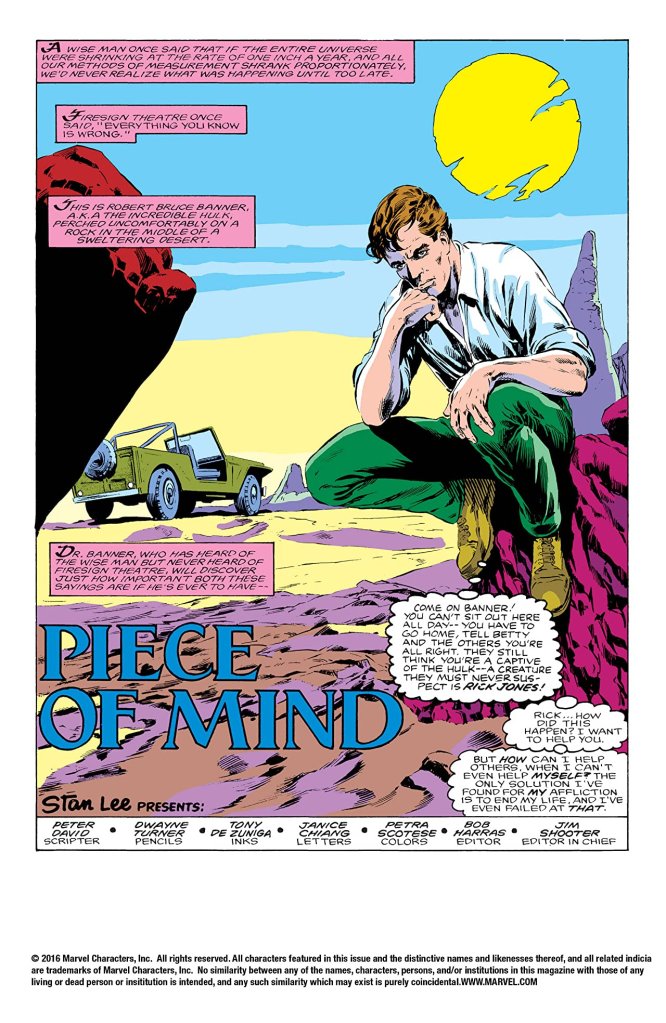
Thoughts on the Issue: Stan Lee once said that every issue of a comic is someone’s first, and therefore the writer should always make it easy for new readers to understand the current plot. When a new writer boards a series, it’s often easier for new readers to start since there’s usually a brief recap of what came before followed by an inciting incident that shows what new directions the series will go in next.

Peter David’s first issue of “The Incredible Hulk” does this reasonably well, though the omnibus I’m reading from has a paragraph before the issue to explain what has just happened. Banner’s internal monologue at the start of the issue gets his problems across clearly, and we of course see the ever-present conflict between him and the Hulk when he looks into a mirage puddle and finds the gray behemoth glaring back at him.

Eventually, Bruce realizes that mulling over his problems in the desert won’t help him, so he decides to return to SHIELD’s Gamma Base where his friends and his wife, Betty, are likely worrying about him. His drive is cut short, however, when he runs into an old man sitting in the middle of the road and overturns his Jeep trying to avoid him. The man claims he has terminal cancer and is waiting for a hired assassin to arrive and kill him so he can die on his own terms. The assassin, Fragment, shows up and immediately begins to antagonize Bruce as well, prompting the Hulk to try to take control and lash out against the threat.
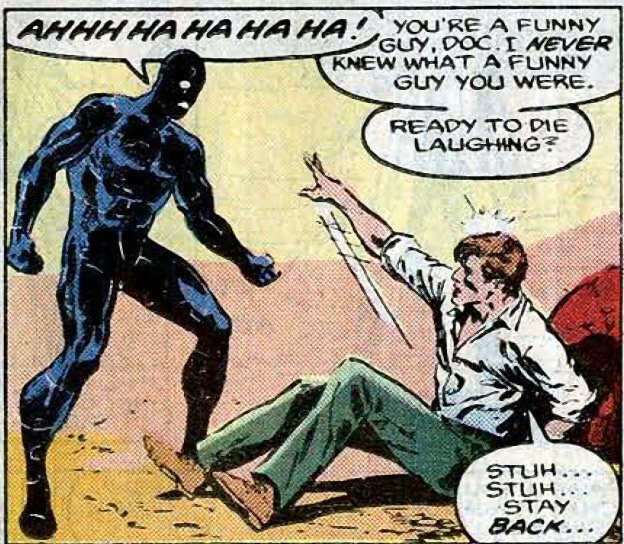
Don’t make him angry. You wouldn’t like him when…well, you know.

Peter David’s run is often lauded for exploring the psychological depths of Bruce Banner like few other writers had before him, and we can see the beginnings of that trend here. Throughout the fight, Bruce has to wrestle not only with the Hulk, who aches to be let loose, but also with his guilt over what has happened to his friend Rick Jones, not to mention his troubled marriage to Betty. Even after the fight against Fragment is over, Bruce contemplates suicide as a means of escaping his problems. It’s even left open to interpretation whether or not the issue’s events really happened or if everything played out in Bruce’s mind.

The ambiguity regarding the reality of what we see is the best part of the issue for me. There are plenty of hints that what is seen isn’t meant to be believed. Fragment seems to already know Bruce, the Hulk, and their origin story even though he wasn’t present for it. If he were a figment of Bruce’s imagination, though, he would know. The revelations near the end (I’ll try to keep issue-specific spoilers out of my reviews while still giving my general thoughts on what they might mean for the story going forward, whether or not I feel they work, etc.) also lend credibility to the argument that none of this is real. On the other hand, there seems to be evidence afterward of the battle between the Hulk and Fragment, so perhaps some parts of it happened and others didn’t. Either way, David’s interest in exploring Bruce Banner’s psyche is already apparent.
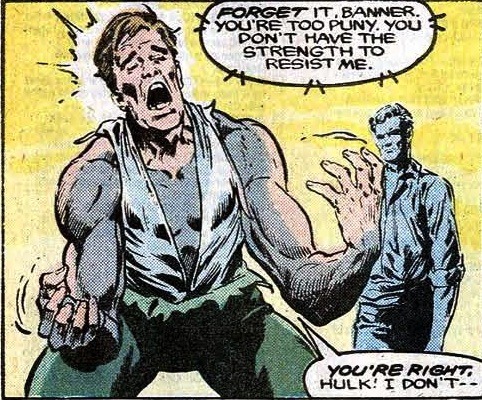
I like how the Hulk’s voice within Bruce is presented as a sort of cross between a thought and a speech bubble. Nice touch.

I’d also like to mention the art in this issue. This is the only issue of Peter David’s run (and I believe the only “Hulk” issue ever) drawn by Dwayne Turner. I hadn’t heard about Turner before reading this issue, but apparently he spent several years in the comic book business before leaving the industry to work on concept art for feature films in Hollywood. I have to say, though, that his work in this issue is remarkably solid. It reminds me a lot of Brent Anderson’s art in “Strikeforce: Morituri”. The action is easy to follow and he conveys the characters’ facial expressions and emotions rather well. Future issues in this run have lots of great art, but I wouldn’t have minded if Turner had stuck around for at least a bit longer.

All in all, this is a decent beginning to Peter David’s run on “The Incredible Hulk”. If the reputation of this run is anything to go by, we’re nowhere near the amazing heights we’ll reach later, but we can see David’s dedication to exploring Bruce Banner’s inner demons. As a mostly standalone issue before his run properly begins (the next two issues were written by Al Milgrom before David fully took over as the ongoing writer), this story works.

Final Rating: 7/10 (Good)

We must solve the public health crisis in order to solve the economic crisis

A common refrain amongst many Americans who oppose stay-at-home orders, mandatory lockdowns and mask-wearing mandates is that while the coronavirus is a serious threat, the risk of contracting the disease is minor compared to the economic damage of such orders, not to mention threats to individual freedom. However, studies of national and state-specific economic data as well as trends in coronavirus infections support a different analysis.

A quick look at the fortunes of Georgia, the first state to begin aggressive economic reopening, reveals that relaxing restrictions is far from a cure-all for unemployment and consumer confidence. In the first few weeks after Governor Brian Kemp began to ease restrictions on April 24, weekly unemployment claims remained notably higher than pre-pandemic levels. Some Georgians were called back to work while others still filed unemployment claims for the first time. Layoffs continued, particularly in the retail, social assistance and health care industries. Additionally, some businesses including restaurants replenished their staff well below capacity, citing lower customer demand.

Consumer confidence is key to the functioning of a healthy economy, and its present absence drives lower demand and with it, higher unemployment. If potential customers are worried about catching the virus, they’re less likely to visit stores and restaurants. Indeed, the Conference Board, which releases the most recent Consumer Confidence Index (CCI) rating every month, claims that the reopening of the economy in some states and decrease of the national unemployment rate in June have caused only a marginal improvement in consumers’ outlook. Lynn Franco, Senior Director of Economic Indicators at The Conference Board, specifically cited national fears of a COVID-19 resurgence as one of the main reasons consumer spending remains well below pre-pandemic levels.

In the past few weeks, the US has seen COVID-19 infection rates reach unprecedented levels, especially in the South and West in states like California, Arizona, Texas and Florida. Florida represents a particularly interesting case study as Governor Ron DeSantis, like Georgia’s Brian Kemp, was one of the last governors to shut his state down and one of the first to begin the reopening process. Florida started loosening restrictions on May 4, and DeSantis allowed local leaders to open their beaches as far back as mid-April. Just a couple weeks later, the Florida governor declared his state’s reopening a success in an interview with the National Review. However, a quick glance at Florida’s economic data reveals that the state unemployment rate actually increased to 14.5% in May from 13.8% the previous month in spite of the state’s reopening.

Despite these meager results, DeSantis continued his reopening plan in June with Phase 2, which allowed for even looser restrictions including letting bars and movie theaters reopen at 50% capacity. It didn’t take long for the coronavirus to surge again, and many record-breaking counts of daily new infections followed. Phase 2 began on June 5, and barely a week later the state surpassed 2,000 new COVID-19 cases a day for the first time. Five days later, Florida surpassed 3,000 new daily cases. Now, with a seven-day average of new cases approaching 10,000, it’s clear that what little economic recovery Florida gained from reopening has come at a steep price. Even Dr. Anthony Fauci, the nation’s top infectious disease expert, said in a podcast discussion Thursday that Florida “jumped over a couple of checkpoints” in its eagerness to reopen.

American businesses are noticing the nation’s troubles with controlling the virus as well. Hollywood film and television productions have been forced to stop filming almost entirely across the board, leaving producers scrambling to find solutions to resume production in the midst of a pandemic. A production executive who spoke anonymously to Variety claimed that producers are “suspicious” of political leadership in states which have reopened quickly and seen subsequent coronavirus surges. Joe Guest, who worked as a production manager on Avengers: Endgame, singled out Florida as “dangerous” and said states that have quelled their outbreaks like New York seem like better places to film. Some productions are looking to leave the US entirely and relocate to sound stages in Europe where many COVID-19 outbreaks are more contained. Upcoming summer blockbusters are preparing to restart production in the UK, not the US. Some European production companies such as Mid Atlantic Films and Studio Babelsberg have received many calls from American producers who want to move their productions overseas. The message is clear: only countries and states which have successfully responded to their COVID-19 outbreaks are under consideration for hosting productions and receiving their accompanying economic benefits.

Even economists have begun extolling the virtues of preventive measures such as mask wearing in recent weeks. On Monday, Goldman-Sachs released a report making a medical and economic case for wearing masks, including a nationwide mandate to do so. The investment bank’s analysis indicates that a federal mandate would greatly slow the spread of the virus and potentially reduce the need for more economic lockdowns. Measures to slow the virus’s spread are often criticized as harmful to the economy or intrusive to one’s personal liberties. However, Goldman-Sachs claims that widespread mask usage will lead to a “sizable” economic boost, and Constance Hunter, chief economist at KPMG, agrees while adding that any economic recovery will come slowly due to the long-term damage the virus has dealt to the labor market.

The economic harm that the coronavirus has dealt to younger workers from the Millennial generation and Gen Z can scarcely be overstated. The oldest members of Generation Z have only recently finished college, and many have had internships and job offers revoked amidst the pandemic assuming they received job offers at all. Nearly a third of Gen Z workers have lost their jobs since the start of the crisis, and studies have shown that young workers who graduate during economic recessions tend to have lower starting salaries, which makes saving for retirement and purchases of homes and cars much harder. Lower starting pay rates often mean that young workers not only start their careers in a weak financial position, but also will need to take years if not decades to start building real wealth. It’s almost exactly a repeat of what happened to Millennials who graduated during the Great Recession in 2008-2009. In fact, Millennials were among the least prepared for the present economic slowdown since they were still recovering from the last one. Not only did Millennials suffer from high unemployment during the late 2000s, but they also had to contend with higher costs of living, tens of thousands of dollars in student debt and poor wages. Now, Millennials could be forgiven for feeling an uncomfortable sense of déjà vu.

If all of the aforementioned evidence isn’t enough, and the disastrous state reopenings, lack of consumer confidence, departing American businesses, pro-mask economist recommendations and substantial virus-induced youth unemployment can’t convince skeptics that the coronavirus must be contained nationwide before economic recovery can begin, then consider the nationwide unemployment rate. President Trump himself has frequently criticized state governors for going into lockdown on the grounds that the economic toll is simply too great. However, even the efforts of governors with aggressive reopening plans barely made a dent in national unemployment. From February to April, unemployment skyrocketed from 3.5% to a staggering 14.7%. After two months of reopenings, the rate lowered to 11.1% in June which, while an improvement, came with dire warnings from Dr. Fauci and other public health experts. Those grim predictions have sadly proven prescient.

The harsh truth is that economic recovery from the present recession will be long and arduous just as the recovery from the crisis of 2008 proved to be. In addition, reopening state economies too soon and too quickly leads to spikes in COVID-19 infections and eventually more deaths which could have been avoided. As long as the coronavirus rages unchecked across entire regions of the nation, consumer confidence will remain low, unemployment will remain high and American firms will look overseas for their business. The present public health crisis must be solved before we can begin to seriously discuss solving the economic one.

Sources:

https://www.investopedia.com/articles/fundamental/103002.asp

https://www.cnbc.com/2020/03/31/us-consumer-confidence-march-2020.html

https://www.cnbc.com/2020/05/26/consumer-confidence-may-2020.html

https://www.conference-board.org/data/consumerconfidence.cfm#:~:text=The%20Conference%20Board%20Consumer%20Confidence%20Index%C2%AE%20increased%20in%20June,improved%20from%2068.4%20to%2086.2.

https://www.businessinsider.com/georgia-reopening-states-arent-seeing-economic-boom-2020-5

https://apnews.com/26f196a8b756af280092c8ac714ba35b

https://www.politico.com/news/2020/05/21/georgia-reopening-coronavirus-jobs-273070

https://www.businessinsider.com/gen-z-careers-derailed-like-older-millennials-if-recession-hits-2020-3

https://www.theatlantic.com/ideas/archive/2020/04/millennials-are-new-lost-generation/609832/

https://www.cnbc.com/2020/06/01/how-the-coronavirus-pandemic-is-shaping-the-future-for-gen-z.html

http://lmsresources.labormarketinfo.com/charts/unemployment_rate.html

https://www.cnn.com/interactive/2020/us/states-reopen-coronavirus-trnd/

https://www.usatoday.com/story/news/nation/2020/06/17/florida-governor-ron-desantis-keeping-state-open-coronavirus-cases-rises/3210417001/

https://www.cnn.com/2020/07/08/politics/ron-desantis-coronavirus-florida/index.html

https://www.clickorlando.com/news/local/2020/05/12/heres-what-to-expect-when-florida-enters-phase-2-of-reopening/

https://www.cnn.com/2020/06/30/business/face-masks-economic-recovery-goldman-sachs/index.html

https://www.cnn.com/2020/07/09/health/us-coronavirus-thursday/index.html

https://www.cnn.com/2020/07/09/health/us-coronavirus-thursday/index.html

Intro to Peter David’s “The Incredible Hulk” Run

Well, here we are: the first official post on my website. Since this site is supposed to be a testament to my love of and personal journey through speculative fiction, I thought I’d start by blogging about a series I’m reading right now.

Anyone who knows me will tell you that I’m a huge comic book fan. Granted, when most people hear that, they assume I’m referring to superheroes, which is fair considering that’s probably the genre most often associated with the medium. It’s certainly the genre I’ve read the most comics about, and therefore my familiarity with it makes me at least somewhat equipped to write about it intelligently.

Not to mention, Peter David’s “Hulk” run just seems like a good place to start blogging. He’s a writer I’ve encountered in my readings before (his work on “Peter Parker, The Spectacular Spider-Man” is great, I just wish Marvel would finally collect that series in Omnibus format so I could read the whole thing), his work with the jolly green giant is the stuff of legend, and it’s long. This run went for about 12 years, so there’s plenty of material to discuss, filled with lots of plot twist and turns.

I’m about 10 issues into my reading of the first omnibus, but I’ll be taking things from the top, starting with issue #328, Peter David’s first on the title.

Overview

Peter David took over as monthly writer for “The Incredible Hulk” in 1987 for the simple reason that nobody else wanted it. The Bill Bixby/Lou Ferrigno-starring TV series had been over for years by then and the comic wasn’t one of Marvel’s best sellers. Most readers at the time were more interested in Spider-Man or the X-Men. The Hulk, while still a legacy character created by Stan Lee and Jack Kirby in their prime, was going through a rough patch.

As David tells it in numerous interviews, Bob Harras (one of the editors) just entered David’s office one day and offered him the book out of the blue. David only eventually said yes because Harras assured him that he wouldn’t have editors constantly scrutinizing his work as had happened during his run on “Spectacular Spider-Man”. Since the Hulk was a lesser-read title, he could get away with adding more of his own personal stamp to the series.

Due to the lengthy nature of his run, David would have the chance to work with a multitude of talented artists over the years including, but not limited to, Dwayne Turner, Todd McFarlane, Jeff Purves, Dale Keown, and George Perez. Each artist would add their own style to their respective issues, giving the run a nice sense of variety.

Sadly, all good things must come to an end, as they say, and that includes David’s work on “The Incredible Hulk”. In 1998, the writer had a dispute with Marvel’s editors that resulted in his firing. His last issue on the series (not including one-shots and specials he wrote in the following years) was #467. All told, Peter David wrote over 130 regular monthly issues for the Hulk, not including annuals and other specials.

I often wonder how much longer David’s run on the series would’ve gone if he’d been allowed to execute his ideas that apparently drew the ire of the editorial team. Would he still be writing the series today? We may never know.

Anyway, let’s get started. Our story begins in issue #328, and Dr. Banner is contemplating his woes in the middle of a desert in the southwestern United States…

Welcome to Praetorian Author!

Hello, and welcome to the website of Praetorian Author! I’m an aspiring science fiction and fantasy writer learning his way through the ropes of the writing craft. One of my goals is to become a full-time fiction reader and writer, and to that end I decided to launch my own website devoted to my love of all things speculative fiction.

On this site you’ll find reviews and discussions of all sorts of sci-fi and fantasy stories. Eventually, I might post my own original works here though I do also intend to submit them to fiction magazines.

Feel free to explore the site, and remember to keep it classy.